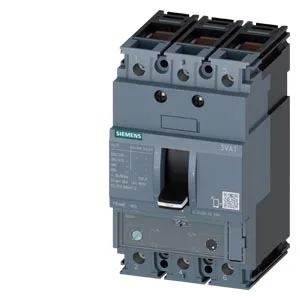
It's a 3-pole unit rated at 63 A at 40 °C, with a TM240 thermal-magnetic overcurrent release — that's the fixed trip unit, so the thermal and magnetic pickup settings are factory-set and not field-adjustable. The 70 mm depth and 76.2 mm width mean it fits the standard SENTRON 3VA frame footprint, so panel layouts already using this family don't need re-spacing.
This breaker delivers 220 kA interrupting capacity at 240 V and still holds 154 kA at 415 V — numbers that put it firmly in the high-fault category for industrial switchboards. At 690 V it drops to 17 kA, so it's not the right choice for a 690 V line with high available fault current; you'd look at the higher-frame SENTRON siblings for that. The 800 V rated insulation voltage (Ui) tells you the internal clearances and creepage are built for 690 V systems with margin, which is typical for MCCBs used in North American 480 V or European 400 V networks.
Thermal derating — the real-world current
The 63 A rating holds flat from 40 °C to 50 °C, then starts a gentle roll-off: 62 A at 55 °C, 61 A at 60 °C, 60 A at 65 °C, and 58 A at 70 °C. That's a linear derating of about 0.4 A per degree above 50 °C. If this breaker sits in a warm enclosure — say a non-ventilated panel near a drive or transformer — the 58 A at 70 °C figure is the one to size against, not the catalog 63 A. The operating range is -25 °C to 70 °C, and storage goes from -40 °C to 80 °C, so it handles cold starts and warehouse storage without issue.
Auxiliary and integration
It ships with two factory-installed HQ auxiliary switches — that's the high-rupturing-capacity type, good for signaling to a PLC or status lamp without extra interposing relays. The trip indicator is absent, meaning no mechanical flag to show a trip event — the auxiliary switches are your only remote indication.