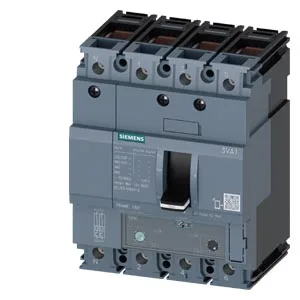
Three poles, rated continuous current Iu of 125 A at 40 °C ambient, and holds that same 125 A all the way up to 50 °C before it starts to taper: 122 A at 55 °C, 120 A at 60 °C, down to 114 A at 70 °C. That's a solid thermal margin for a warm panel. Breaking capacity is where this one earns its keep: 76 kA at 240 V, 53 kA at 415 V, 32 kA at 440 V, and still 5 kA at 500 V and 690 V. For a 125 A frame, that 76 kA at 240 V gives you real selectivity headroom on a 240 V industrial service — you can coordinate downstream without cascading every fault upstream. The overcurrent release is a TM240 thermal-magnetic, so it's a fixed-trip breaker, no interchangeable rating plug.
Height is 130 mm, width is 3 in — standard MCCB footprint for a 3-pole 125 A frame. The TM240 release is factory-set, so no field-adjustable thermal or magnetic dials — you spec the trip curve and it stays. Mechanical endurance is 15,000 operations — fine for a distribution breaker that sees occasional switching, not a daily contactor replacement. If you need remote monitoring or UVR, you're in a different variant. The trip indicator and voltage trigger are present, so you get local visual trip indication and a voltage-based trip signal.