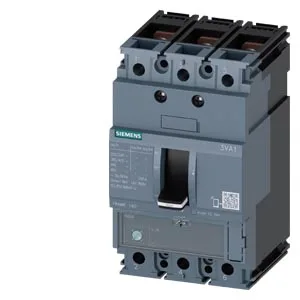
The TM220 overcurrent release combines a thermal bimetal for overload protection and a magnetic coil for short-circuit response, both fixed and non-interchangeable. Rated 16 A continuous at 40 °C through 55 °C, it derates to 15 A at 60 °C and holds that to 70 °C — so in a warm enclosure you lose 1 A of headroom. The interrupting ratings are the headline: 187 kA at 240 V, 121 kA at 415 V, 75.6 kA at 440 V, and 17 kA at 500 V and 690 V.
Sizing and selectivity in the panel
At 16 A with a TM220 release, this breaker coordinates downstream with 10 A or 16 A MCBs in a typical IEC 60947-2 cascade — the magnetic trip threshold (around 320 A for a TM220) gives enough gap to avoid nuisance tripping on motor inrush while still clearing a bolted fault upstream of a branch. Power loss is 10.6 W maximum — negligible for a single breaker, but if you're packing ten of these in a panel, that's 106 W of heat that needs to leave the enclosure.
Dimensions: 70 mm deep, 76.2 mm wide (3 inches), 130 mm tall (5.12 inches). That 76.2 mm width is a standard 3-pole MCCB footprint — it occupies three 25.4 mm (1-inch) module positions on a DIN rail or direct-mount plate.