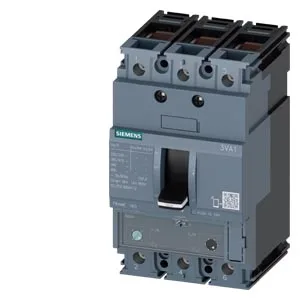
The Siemens SENTRON 3VA1196-5EF36-0AH0 is a 3-pole molded case circuit breaker (MCCB) rated for line protection, with a continuous current rating of 16 A that holds flat from 40 °C through 50 °C before derating begins — at 55 °C it's still good for 15.36 A, and at 70 °C it delivers 14.4 A. That thermal stability means the breaker doesn't force a panel derating exercise in a warm enclosure unless ambient climbs above 50 °C. The interrupting capacity is the headline: 187 kA at 240 V, 121 kA at 415 V, 75.6 kA at 440 V, and 17 kA at 690 V. At 690 V the 17 kA rating still clears a stiff industrial bus. That makes it a straightforward drop-in for a BOM that doesn't need selective coordination tuning.
Dimensions are 130 mm height, 76.2 mm width, 70 mm depth — a compact 3-pole footprint that fits standard DIN-rail or screw-mount panel layouts.
What the TM240 release means for coordination
The TM240 designation indicates a thermal-magnetic trip unit with a fixed thermal pickup at 16 A (the rated continuous current) and a fixed magnetic instantaneous trip. There is no adjustable time delay (tr max. is 1 second per the spec), so this breaker coordinates as a standard instantaneous MCCB — it clears fast on short-circuit, which is fine for branch protection but not for selective coordination where you need a delayed trip downstream of a main breaker. If your coordination study calls for an electronic trip with adjustable I²t curves, this is not the variant; if you need a simple, reliable, non-adjustable branch breaker, it is.