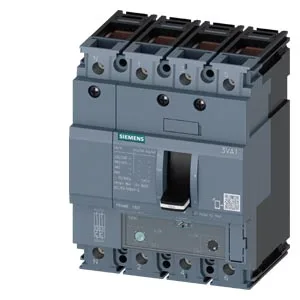
What this MCCB is and where it fits
The Siemens 3VA1196-5GF46-0AA0 is a SENTRON molded case circuit breaker (MCCB) rated for 16 A continuous current across a 4-pole configuration, with a TM240 thermal-magnetic trip unit that handles both overload and short-circuit protection without external control wiring. This is a line-protection design — no undervoltage release, no ground-fault monitoring, no communication module — so it's a straight feeder or branch-circuit protector for panels where you don't need remote trip signaling or GFCI integration. With an 800 V rated insulation voltage and an IP40 front face, it's suited for installation inside a distribution board or enclosure where the front is behind a door; the IP40 rating means tools or fingers won't accidentally contact live parts from the front, but the body isn't sealed against washdown.
Breaking capacity — what the numbers mean for coordination
The interrupting rating drops sharply as system voltage rises: 187 kA at 240 V, 121 kA at 415 V, 75.6 kA at 440 V, and 17 kA at 500 V and 690 V. That 17 kA floor at 690 V is the figure to check if you're feeding a 600 V class motor control center — most 600 V MCC bus bracing is rated 25 kA or 42 kA, so this breaker may need a current-limiting upstream device to coordinate. The thermal-magnetic TM240 trip unit holds full 16 A rating from 40 °C through 55 °C ambient, then derates to 15 A at 60–70 °C. That flat curve through 55 °C gives you headroom in a warm enclosure without oversizing the frame.
Panel footprint and integration
The 3VA1196-5GF46-0AA0 measures 130 mm high, 101.6 mm wide, and 70 mm deep — a 4-pole MCCB that fits a standard 100 mm wide DIN or panel-mount slot. The 10.6 W maximum power loss at full load means it won't cook adjacent components in a dense enclosure, but you still want a few millimeters of air gap around the vents. Operating temperature range is -25 °C to +70 °C, storage from -40 °C to +80 °C. That covers most indoor industrial environments including unheated warehouses; the storage range is wide enough for seasonal shutdowns.
Lifecycle and sourcing
Pricing and availability are confirmed at quote time against an RFQ; this is a standard catalog item, not a legacy or special-build part, so lead times are typically predictable through the Siemens supply chain.
