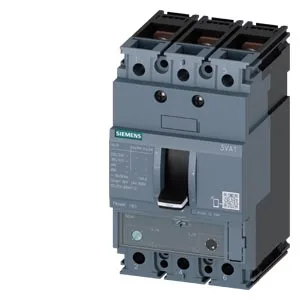
It carries a 16 A continuous rating at 40 °C (derated to 15 A at 60 °C and above) across three poles, with a TM240 thermal-magnetic overcurrent release. The TM240 designation means the thermal trip element is fixed at 16 A; the magnetic short-circuit pickup is set at 240 A (15× In). That's a deliberate coordination choice — high inrush loads like motor starters or transformer primaries won't nuisance trip on magnetizing current, but a bolted fault clears decisively. Breaking capacity is the headline number here: 220 kA at 240 V AC, 154 kA at 415 V, 121 kA at 440 V, and still 17 kA at 690 V.
Footprint: 76.2 mm wide (3 in), 130 mm tall (5.12 in), 70 mm deep (2.76 in). If you need remote trip indication or undervoltage protection, you'd step to a different 3VA option code. Power dissipation is 10.6 W maximum at rated load. In a densely packed panel, that heat needs to be accounted for in the thermal budget — especially if multiple breakers are ganged in a row with no forced ventilation.
In a 480 V panel, the interrupting capacity drops to 154 kA at 415 V and 121 kA at 440 V — still very high, but you need to verify the available fault current at the installation point. At 690 V it's 17 kA, which is adequate for most 690 V distribution but not for high-fault 690 V switchgear. The TM240 release (240 A magnetic pickup) means this breaker will ride through motor starting currents up to about 15× rated current — a standard 16 A MCCB with a 10× pickup might trip on a large motor's inrush; this one won't. The 16 A continuous current is stable across 40 °C to 55 °C (no derating needed in that band); above 55 °C it derates to 15 A. Plan the load accordingly.