What this MCCB carries — and what it doesn't
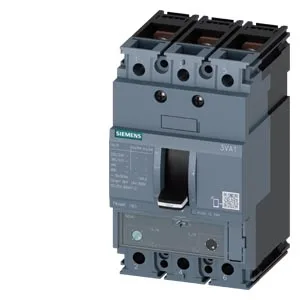
The Siemens SENTRON 3VA1196-6EF32-0HH0 is a 3-pole molded case circuit breaker rated for 16 A continuous current with a TM240 thermal-magnetic overcurrent release. The interrupting capacity is the headline here: 220 kA at 240 V, 154 kA at 415 V, 121 kA at 440 V, and 17 kA at 690 V. That 220 kA figure at 240 V means this breaker can safely clear a fault up to that level without rupturing — critical for high-fault panels near large transformers or utility feeds. The TM240 release means the thermal element handles overloads, the magnetic element handles short circuits; no electronic adjustment, no communication module, no ground-fault monitoring. It ships with a shunt trip (STL) for remote tripping and carries 2 auxiliary switches plus 1 trip alarm switch (HQ configuration).
Thermal derating — the real continuous current at panel temperature
The 16 A rating holds flat from 40 °C through 50 °C. At 55 °C it derates to 15.36 A, at 60 °C to 15.04 A, at 65 °C to 14.72 A, and at 70 °C to 14.4 A. If your panel ambient runs above 50 °C, the load current must be adjusted accordingly. The operating range spans -25 °C to 70 °C; storage range is -40 °C to 80 °C. The front face carries IP40 protection — fine for a closed panel, not for washdown zones.
Panel fit — dimensions and mounting
The breaker measures 130 mm height, 76.2 mm width, 70 mm depth. It mounts on a DIN rail or can be screw-fixed to a backplate. The 70 mm depth means it clears most standard gland plates and shallow enclosures. The 3VA family uses a common footprint across the 16 A to 160 A range, so panel cutouts and busbar layouts transfer between frame sizes.
What the auxiliary configuration gives you
The factory-fitted auxiliary contact block provides 2 normally-open/normally-closed auxiliary switches plus a separate trip alarm switch. The trip alarm signals when the breaker has tripped on overload or short circuit — distinct from the aux switches that follow the main contact position. This matters for remote status monitoring: the trip alarm can trigger a PLC input or an alarm beacon independently of the breaker's on/off state. The shunt trip (STL) allows remote tripping via a control voltage; no undervoltage release is fitted.
