What this 200 A MCCB delivers — and what the ratings actually mean
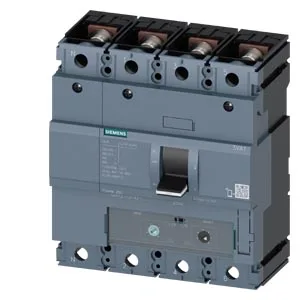
The Siemens 3VA1220-4FF42-0AA0 is a SENTRON molded case circuit breaker rated for 200 A continuous current at 40 °C, with no derating required up to 50 °C — it holds the full 200 A through that range. Above 50 °C the thermal curve steps down: 194 A at 55 °C, 188 A at 60 °C, 182 A at 65 °C, and 176 A at 70 °C. That means in a warm panel (say 55 °C ambient) you lose 6 A of headroom; plan the load margin accordingly. This is a straightforward line-protection breaker for distribution panels where you don't need adjustable curves or remote signaling. Breaking capacity varies sharply with system voltage: 121 kA at 240 V, 75.6 kA at 415 V, 52.5 kA at 440 V, 17 kA at 500 V, and 11.9 kA at 690 V. At 415 V — common in European industrial distribution — the 75.6 kA rating covers most transformer-fed fault levels.
Footprint and panel integration
Dimensions are 140 mm wide, 158 mm high, 70 mm deep. The 140 mm width is a 4-pole frame; a 3-pole sibling would be narrower. No undervoltage release or shunt trip is fitted, so if you need remote tripping you'll add an external module or specify a different variant.