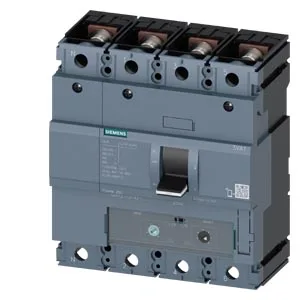
What this 200 A MCCB delivers
The Siemens SENTRON 3VA1220-4GF42-0AG0 is a 4-pole molded case circuit breaker rated for 200 A continuous at 40 °C, with a TM240 thermal-magnetic overcurrent release. The interrupting ratings climb to 121 kA at 240 V and 75.6 kA at 415 V, which gives selectivity headroom for high-fault installations like industrial substations or large motor control centers. If the load grows beyond that, you swap the whole breaker, not just the trip.
Interrupting capacity across voltage levels
This MCCB delivers 121 kA at 240 V, 75.6 kA at 415 V, 52.5 kA at 440 V, 17 kA at 500 V, and 11.9 kA at 690 V. That's a steep derate curve above 440 V, which is typical for a compact MCCB frame. On a 480 V system the 52.5 kA rating still covers most utility transformer sizes; on a 690 V wind or marine circuit the 11.9 kA limit means you need to verify the available fault current at the panel.
Above that it derates: 194 A at 55 °C, 188 A at 60 °C, 182 A at 65 °C, and 176 A at 70 °C.
Built-in auxiliary and alarm switching
The trip alarm signals only on a fault trip — not on manual switching — so it can trigger an alarm annunciator or a shunt-trip lockout circuit. No undervoltage release or communication module is included; those would need to be added externally if required.