What the ratings mean for fit
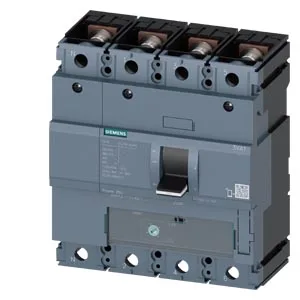
The Siemens SENTRON 3VA1220-5GE42-0AA0 is a 4-pole molded case circuit breaker rated 200 A continuous — that's the full-load current it carries without tripping, not a pickup setting. The TM220 overcurrent release combines a thermal element for overload protection and a magnetic element for short-circuit response; it's a fixed-trip design, so the 200 A rating is the breaker's identity, not an adjustable range. Breaking capacity is where this breaker earns its panel space: 187 kA at 240 V, 121 kA at 415 V, 75.6 kA at 440 V, 30 kA at 500 V, and 17 kA at 690 V. Those numbers tell you the maximum fault current it can safely interrupt at each voltage level — critical for SCCR compliance on a distribution board feeding motor control centers or downstream subpanels. At 415 V, the 121 kA rating covers most industrial service-entrance applications without needing a current-limiting fuse upstream. Temperature derating is built into the spec: the breaker holds 200 A from 40 °C through 50 °C, then drops to 194 A at 55 °C, 188 A at 60 °C, 182 A at 65 °C, and 176 A at 70 °C. If your panel ambient runs above 50 °C, you size the downstream load to the derated current, not the nameplate 200 A. The 42 W maximum power loss at rated load helps estimate heat contribution inside the enclosure.
Panel integration and mounting
The 3VA1220-5GE42-0AA0 measures 70 mm deep, 140 mm wide, and 158 mm high — a compact footprint for a 200 A 4-pole MCCB. It's designed for DIN-rail mounting or direct screw-fixing to a backplate. The IP40 protection on the front face means it's protected against tools and small wires entering the breaker, but not against water ingress; keep it inside a panel with at least an IP54 enclosure if the environment has washdown or condensation. Rated insulation voltage is 800 V, so the breaker's internal clearances and creepage distances are sized for 690 V systems with margin. The operating temperature range is -25 °C to 70 °C, with storage from -40 °C to 80 °C — the storage limit governs handling during transport, not running conditions.
