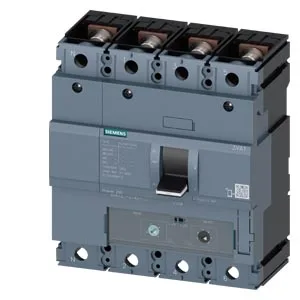
What this MCCB carries and where it fits
The Siemens SENTRON 3VA1220-6EF42-0HA0 is a 4-pole molded case circuit breaker (MCCB) rated for 200 A continuous current (Iu) with a TM240 thermal-magnetic overcurrent release. Its breaking capacity hits 220 kA at 240 V and 154 kA at 415 V — figures that put it squarely in the high-interrupting category for industrial main feeders and large sub-distribution boards. The 70 mm depth and 158 mm height keep the footprint manageable for a 200 A frame, though the 140 mm width across four poles means the panel cutout and busbar spacing need to accommodate the full pole count. This is a line-protection variant, meaning the TM240 release is set for cable and busbar protection rather than motor or generator duty. The 800 V rated insulation voltage (Ui) gives headroom for 690 V systems, where the breaking capacity still holds at 17 kA. The shunt trip (STL) auxiliary release allows remote tripping via a control signal — useful for emergency-stop circuits or supervisory shutdown sequences. No undervoltage release, no auxiliary contacts, no ground-fault monitoring are fitted on this order code, so any of those functions would need an external module or a different variant.
Thermal derating and ambient limits
The 200 A rating holds flat from 40 °C through 50 °C ambient. Above that, the TM240 release begins to thermally track: 194 A at 55 °C, 188 A at 60 °C, 182 A at 65 °C, and 176 A at 70 °C. If the panel ambient runs hot — say, a non-ventilated enclosure near a furnace line — the continuous current must be downrated accordingly. The operating temperature range spans -25 °C to 70 °C, with storage from -40 °C to 80 °C.
Front protection and mechanical endurance
IP40 on the front means the breaker face is protected against tools and solid objects over 1 mm, but not sealed against water ingress — standard for indoor switchgear panels. The latching endurance is rated at 15 000 operations, which is typical for a distribution MCCB not cycled frequently. No trip indicator is fitted, so fault events must be identified by the breaker position or a separate indication circuit.
