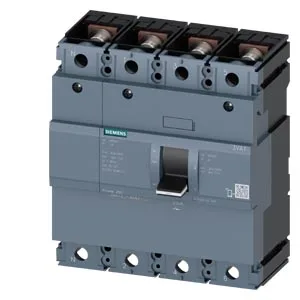
It's designed to isolate a circuit under load — no overload or short-circuit protection built in, so it's a pure disconnect for maintenance isolation or as a line-side switch ahead of a downstream protection device. That puts it squarely in industrial power distribution — motor control centres, panel main switches, or as a load-break disconnect for a machine cell. Busbar connection on the main circuit, front terminals, so it's meant for busbar-stacked or cable-fed distribution blocks, not screw-clamp wiring direct to the lugs.
Above that it starts to step down: 243 A at 55 °C, 237 A at 60 °C, 230 A at 65 °C, and 223 A at 70 °C. That's a clean linear derate curve — about 1.4 A per degree above 50 °C. Maximum power dissipation is 57 W at rated current.
Auxiliary contacts and options
Comes with one auxiliary switch (form C, 2 CO contacts) plus one trip alarm switch HP — both built in. That's enough for a remote status indication and a separate alarm signal if the disconnect trips on an external fault.
Width 140 mm, height 158 mm, depth 70 mm. That is a standard MCCB footprint — mounts on a backplate or DIN rail via the nut keeper kit included. That's adequate for a main disconnect that sees a few operations a day; for frequent switching duty you'd want a contactor instead.