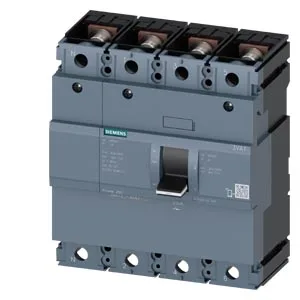
The Siemens 3VA1225-1AA42-0HC0 is a SENTRON switch disconnector in MCCB design, rated for 250 A continuous current (Iu) across 4 poles. It carries no overload or short-circuit protection — this is a pure disconnect, not a breaker. The front terminal accepts busbar connections, so this lands in a panel where the main bus feeds directly through the disconnect to downstream loads — typical for a machine infeed or sub-distribution board.
The 250 A rated continuous current (Iu) sets the maximum load this disconnect can carry without derating. At 57 W max power loss, the heat it dumps into the enclosure is manageable in a ventilated panel, but a sealed stainless box at 70 °C ambient will need a thermal check — the operating range tops at 70 °C. That matches its role as a load-break switch, not a circuit breaker. IP40 on the front means it keeps out tools and wires larger than 1 mm, but it is not sealed against washdown. This is a dry-panel part — indoor, switchgear or MCC enclosure.
The front busbar connection means it bolts directly to the horizontal bus in a distribution panel or switchboard — no wire lugs needed. The shunt trip coil and auxiliary contacts are wired separately via the front terminal block. For high-duty switching, you would add a contactor downstream.