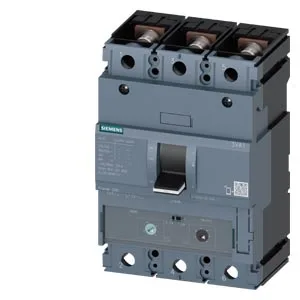
What this MCCB does on the line
The Siemens SENTRON 3VA1225-6EF32-0AH0 is a 3-pole molded case circuit breaker (MCCB) rated for line protection at a continuous current Iu of 250 A. It carries a TM240 thermal-magnetic trip unit — fixed thermal, magnetic adjustable — sized for feeder or large motor branch protection where you need the interrupting capacity to handle a stiff source. At 240 V it clears 220 kA; at 415 V it still holds 154 kA. That kind of SCCR headroom means it can sit right behind a transformer or on a high-fault bus without cascading upstream. The interrupting curve drops predictably as voltage climbs: 36 kA at 440 V, 17 kA at 690 V. If you're on a 480 V system (common in North American industrial) the 440 V figure is the closest published — 36 kA is still a serious number for a 250 A frame. The insulation rating is 800 V Ui, so it's comfortable on 600 V class gear.
Thermal derating — the real-world current
The 250 A rating holds flat from 40 °C to 50 °C ambient. Above that it derates: 243.3 A at 55 °C, 236.5 A at 60 °C, 229 A at 65 °C, and 223 A at 70 °C. If your panel runs hot — say 55 °C inside the enclosure — you lose about 7 A off the nameplate. That's a design margin to watch when sizing the feeder.
Physical fit and wiring
The can measures 105 mm wide, 158 mm tall, 70 mm deep. That's a standard 3-pole MCCB footprint for the 250 A frame class — it'll drop into most SENTRON panelboards and distribution blocks without re-drilling. The front face carries an IP40 rating, which is typical for a dead-front panel installation; keep it behind a gland plate or enclosure door. Auxiliary contacts are built in: 2 auxiliary switches plus 1 trip alarm switch, all HQ (high-quantity) rated. That gives you two N.O./N.C. sets for status feedback to a PLC or annunciator, plus a separate alarm contact that only changes state on a trip — useful for differentiating a manual open from a fault.
