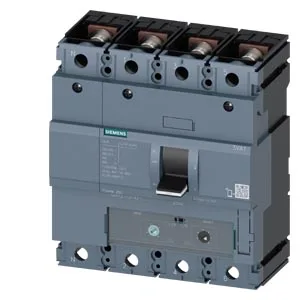
The undervoltage release (UVR) is built in — part 3VA9608-0BB11 for the auxiliary trip — and the auxiliary contact block ships with 2 HQ-form switches. This is the breaker you specify when the panel needs a coordinated 250 A feed with a UVR for safety isolation and the interrupting rating has to cover high-fault utility feeds.
Breaking capacity — the number that decides the fit
This breaker's interrupting rating changes sharply with system voltage. At 240 V it clears 220 kA — that is utility-transformer-level fault current, enough for service-entrance or large sub-feed applications. At 415 V the rating drops to 154 kA, still well above typical industrial secondary-side fault levels. The so-what: if your panel is on a 480 V or 400 V system, the 36 kA or 154 kA figure governs the SCCR coordination study, not the headline 220 kA number. The TM240 release and 250 A continuous rating hold flat through 50 °C; above that the current derates to 243.3 A at 55 °C, 236.5 A at 60 °C, 229 A at 65 °C, and 223 A at 70 °C. If the ambient inside the enclosure runs above 50 °C, the load must be downsized or the breaker upsized.
The 3VA1225-6GF42-0BC0 measures 70 mm deep, 140 mm wide, and 158 mm high. The 4-pole construction covers three-phase plus neutral (100 % N-conductor protection). No trip indicator on the front face, so remote signaling relies on the 2 HQ auxiliary switches.