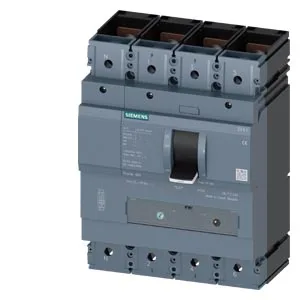
That 400 A holds steady up through 50 °C; at 55 °C it's 392 A, and at 70 °C still 367 A (–). The TM240 thermal-magnetic release handles the overload and short-circuit curves. On the interrupting side, it's rated 440 kA at 240 V AC, 242 kA at 415/440 V, 154 kA at 500 V, and 17 kA at 690 V (–). It lives on a DIN rail or direct-mount in a panel; the 184 mm width and 110 mm depth (–) mean it fits standard MCCB cubicle cutouts, but verify the mounting centers if you're swapping into an older footprint.
If your panel ambient runs hotter, the derating curve is published: 392 A at 55 °C, 384 A at 60 °C, 376 A at 65 °C, 367 A at 70 °C (–). The TM240 release means the thermal element is calibrated for a 400 A frame with a 240 A rating plug — verify the actual trip setting matches your load's FLA. The 440 kA interrupting rating at 240 V is the SCCR you can claim downstream; at 690 V it drops to 17 kA, so if you're feeding a 690 V drive or transformer, the available fault current must be coordinated. The 4-pole design with 100% N-conductor protection means the neutral is fully rated and switched — essential for 4-wire systems where harmonic currents or unbalanced loads could overload a reduced-neutral path.