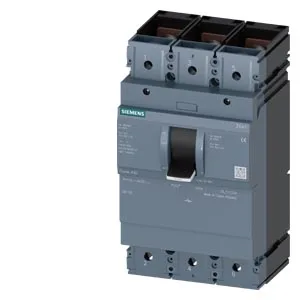
It comes with an undervoltage release that operates on 24 V DC, and it ships with the nut keeper kit for the main circuit connections. This is a bare disconnect — no overload or short-circuit protection built in — so it's meant for applications where isolation and switching are the only job, and protection is handled upstream or by a separate device.
What the 630 A rating means for fit
The 630 A continuous rating tells you this disconnect handles full-load currents up to that level in a panel. For a motor load, that's roughly a 315 kW induction motor at 400 V — but since this is a switch disconnector without overload protection, it's the isolation function you're buying, not the motor-starting duty. The frame 630 footprint means it occupies the same panel cutout as the 3VA1 molded-case breakers at that frame size, so if you're replacing a breaker that failed and switching to a fused disconnect scheme, the bus-bar layout stays the same.
Undervoltage release — what it does on site
On a machine line, that's your safety chain: if the 24 V control supply fails or an E-stop kills it, the disconnect opens and isolates the load. No separate shunt-trip wiring needed. The release is factory-fit on this order code, so you're not field-retrofitting it — it arrives ready to wire into the 24 V DC control circuit.