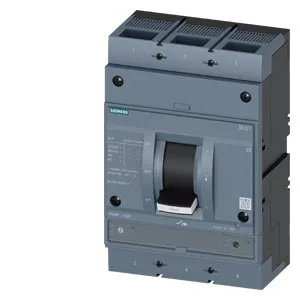
The Siemens 3VA1580-5GF42-0LG0 is a 4-pole IEC circuit breaker in the 3VA1 family, frame size 1000, with a breaking capacity class M rated at 55 kA at 415 V AC. That interrupting rating tells you it can clear a bolted fault up to 55 kA without failing — critical for downstream coordination on 415 V industrial mains where available fault current can exceed 50 kA. The thermal-magnetic trip TM240 gives an overload range Ir = 560…800 A and a short-circuit pickup Ii = 5…10 × In, so you can dial the long-time pickup to match cable or motor full-load amps and set the magnetic threshold to ride through motor inrush. This is a line-protection breaker, not a motor-circuit protector — the TM240 curve is designed for feeder and distribution duty. The 100 % N-conductor protection means the neutral pole is fully rated and trips with the phases, which matters for 4-wire systems where a neutral overload could otherwise go undetected.
Because the part is active, lead times typically follow standard Siemens distribution cycles — confirm current pricing and delivery window at quote time.
This breaker mounts in a standard IEC switchboard or panel — frame 1000 means it occupies the physical footprint of a 1000 A molded-case breaker. The 4-pole configuration with 100 % neutral protection requires a full-width neutral pole; verify your panel's neutral bar and bus-stub clearance for a 4-pole device. The TM240 trip unit is field-adjustable: Ir from 560 to 800 A via a dial, Ii from 5× to 10× In via a separate rotary switch. Set these before energizing — the magnetic pickup at 5× In (4000 A) may be too low for a large motor starting transient; 10× In (8000 A) gives more headroom. The universal release coil is 24 V DC. If you are wiring it into a 24 V DC control circuit, confirm the coil's inrush and seal current do not exceed the PLC output or relay rating. The auxiliary switch is a changeover contact rated for standard control voltages.