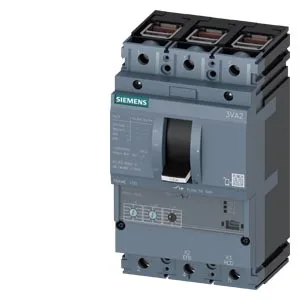
It carries 100 A continuous at 40 °C, 45 °C, and 50 °C without derating; above 55 °C the current steps down in 3.75 A increments to 85 A at 70 °C. The ETU320 electronic trip unit handles the overcurrent protection curve, and the built-in undervoltage release (UVR) drops the breaker if control voltage falls below the dropout threshold — a standard safeguard for emergency-stop and undervoltage ride-through schemes. The interrupting ratings are the headline: 187 kA at 240 V, 121 kA at both 415 V and 440 V, 79 kA at 500 V, and 3.4 kA at 690 V. The 690 V figure is low enough that you'd check coordination if the breaker feeds a 690 V drive; the 3.4 kA ceiling is the weak point in an otherwise high-interrupting device.
Panel fit and physical integration
Auxiliary and control wiring
The breaker ships with two integrated HQ auxiliary switches (form C, high-qualified contacts) and an undervoltage release (UVR) pre-installed. The UVR is the 3VA9608-0BB11 auxiliary trip unit — it's a separate order code but comes factory-fitted on this variant. The auxiliary switches are wired to the terminal block on the breaker face; they share the same coil suppression as the UVR, so verify polarity if you're driving the UVR from a DC control supply. No communication module or phase-failure detection is included — this is a basic line-protection MCCB, not a smart breaker.
It means the breaker is suitable for 690 V systems (the highest operating voltage in the interrupting table) with margin. For a panel running at 55 °C ambient (common in sealed outdoor enclosures), the breaker is good for 96.25 A — still within a 100 A feeder's nominal load.