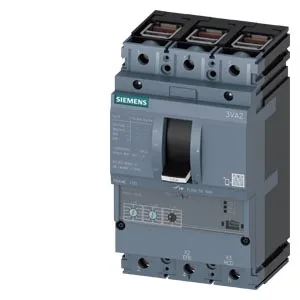
That 100 A holds steady at every 5 °C increment, so it's sized for a 100 A feeder or a 100 A motor branch circuit without having to oversize for a hot panel. Three-pole design, line-protection configuration, and an integrated undervoltage release (UVR) that drops the breaker if control voltage is lost — common in safety circuits where a loss of 24 VDC or 120 VAC control power needs to kill the load.
The interrupting ratings climb with system voltage: 187 kA at 240 V, 121 kA at 415 V and 440 V, 75.6 kA at 500 V, and 3 kA at 690 V. The 100 A frame carries a minimum trip setting of 150 A and a maximum of 1 200 A — that's the magnetic (instantaneous) pickup range, not the continuous rating. For a 100 A feeder, the thermal element is fixed at 100 A; the magnetic adjustment lets you coordinate with downstream breakers or motor starters without changing the frame.
That 105 mm width is the standard 3-pole MCCB footprint for the 3VA frame — it fits the same panel cutout and bus-bar spacing as other 3VA 100 A units. The auxiliary switch block is pre-configured with four HQ auxiliary switches (form C contacts). That's enough for remote status indication (open/closed/tripped) plus a spare pair for a PLC input or a panel lamp. The undervoltage release is a separate coil module that mounts on the left side of the breaker; it's wired in series with the control transformer or safety relay output.