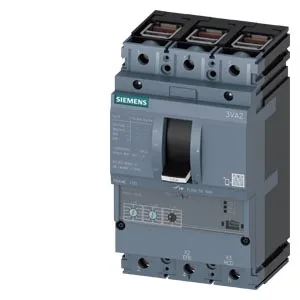
The Siemens 3VA2010-5HL36-0CA0 is a SENTRON 3VA2 molded case circuit breaker rated for 100 A continuous current (Iu) across a 3-pole configuration, fitted with an ETU320 line protection trip unit.
Short-circuit breaking capacity is voltage-dependent: 187 kA at 240 V, 121 kA at 415 V and 440 V, 79 kA at 500 V, and 3.4 kA at 690 V. At 480 V (common in North American plants) you'd interpolate between the 440 V and 500 V figures — it's still a high-fault breaker. Above that it derates: 96.25 A at 55 °C, 92.5 A at 60 °C, 88.75 A at 65 °C, and 85 A at 70 °C.
What the ETU320 trip unit does
The ETU320 is an electronic overcurrent release with LI (long-time and short-time) protection, no ground-fault function on this variant. It's line-protection only — no communication module, no phase-failure detection, no voltage trigger. The -0CA0 suffix adds the undervoltage release coil, which is a separate device (order code 3VA9608-0BB24) integrated at the factory.