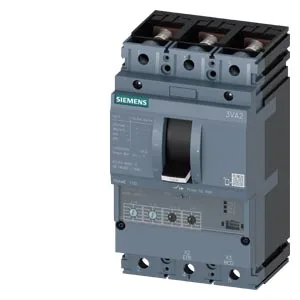
The breaking capacity is serious: 187 kA at 240 V, 121 kA at 415 V and 440 V, 79 kA at 500 V, and still 3.4 kA at 690 V. That kind of interrupting ability at the lower voltages tells you it's meant for high-fault panels where an ordinary MCCB would weld shut. That's the difference between a breaker that trips blind and one that lets you hold selectivity. The 3VA2 frame size (105 mm wide, 181 mm tall, 86 mm deep) fits standard panel-mount cutouts; the IP40 front means it's splash-protected on the face, but don't hose it down — this is a dry-gear breaker.
Thermal derating — what the 100 A means at panel ambient
At 55 °C it's 96.25 A, at 60 °C it's 92.5 A, at 65 °C it's 88.75 A, and at 70 °C it's 85 A. That's a wide thermal window; it'll survive a cold warehouse and a hot enclosure.
Auxiliary contacts and trip unit
The ETU350 trip unit handles the overcurrent protection; the breaker itself has no voltage trigger, no phase-failure detection, and no communication function. It's a straightforward line-protection MCCB — you wire the load, set the trip thresholds, and it sits there interrupting faults until the end of its 20,000-cycle mechanical life.