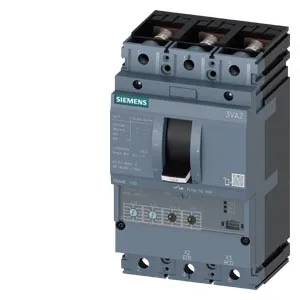
Breaking capacity sits at 187 kA at 240 V and 121 kA at 415 V, dropping to 3 kA at 690 V — that 187 kA figure covers most US 277/480 V panelboard fault levels, while the 415 V rating handles European 400 V distribution without needing a current-limiting upstream device.
Panel fit and thermal derating
Dimensions are 105 mm wide, 181 mm tall, 107 mm deep — that 105 mm width is a standard 3-pole MCCB footprint for a 100 A frame, so it drops into most existing SENTRON or 3VA-series panelboards without re-drilling the mounting plate. Rated continuous current holds at 100 A from 40 °C through 50 °C ambient; above that it derates linearly to 96.25 A at 55 °C, 92.5 A at 60 °C, 88.75 A at 65 °C, and 85 A at 70 °C — if your panel runs hot near the top of the enclosure, account for the 15 A drop at 70 °C when sizing the feeder. Maximum power loss is 15 W — negligible for most enclosures, but if you're packing multiple breakers in a sealed cabinet, sum the losses and check the temperature rise against the derating curve above.
What the ETU350 trip unit gives you
The ETU350 is an electronic trip unit with LSI protection — long-time (overload), short-time (short-circuit with intentional delay for selectivity), and instantaneous. That short-time delay is what lets you coordinate this breaker with downstream MCCBs so a fault on a branch doesn't take out the whole panel.