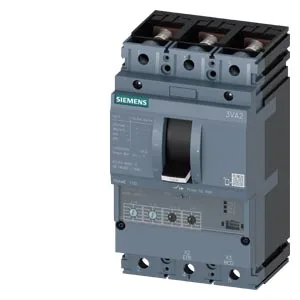
Rated 100 A continuous across the full 40–70 °C ambient range, so no derating curve to chase in a warm enclosure.
Interrupting capacity — the number that decides selectivity
This MCCB's interrupting capacity drops with system voltage: 187 kA at 240 V, 121 kA at 415 V and 440 V, 75.6 kA at 500 V, and 3 kA at 690 V. For a 100 A frame, 187 kA at 240 V is high — it means this breaker can sit ahead of a transformer or on a high-fault bus without needing a current-limiting fuse upstream. At 690 V the 3 kA figure is modest; in a 690 V system you'd check that the available fault current stays under that limit, or step up to a higher-rated frame.
The 3VA2010-5HN32-0CA0 measures 105 mm wide, 181 mm tall, and 86 mm deep — a standard 3-pole MCCB footprint that drops into a SENTRON distribution panel or a generic DIN-rail / mounting-plate layout. The 86 mm depth means it clears most shallow enclosures; the 105 mm width is the same as other 100 A SENTRON frames, so busbar and lug kits transfer without rework.
The 100 A continuous rating at 40–70 °C is flat — no derating needed up to 70 °C, which is unusual for an MCCB and simplifies panel thermal calculations. The 800 V rated insulation voltage (Ui) means this breaker is electrically rated for 690 V systems with margin; the interrupting capacity at 690 V (3 kA) is the practical limit, not the insulation.