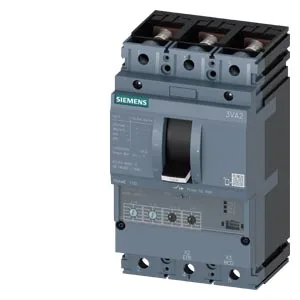
It carries 100 A continuously at 40 °C ambient through three poles, with an ETU350 electronic trip unit that handles the overcurrent release logic — adjustable, so you set the pickup and delay to match the downstream cable or load, not the other way around. The 187 kA breaking capacity at 240 V AC means it can interrupt a fault current up to that level without the arc re-striking or the case rupturing; that's a high-interrupting rating for a 100 A frame, sized for strong utility feeds or transformer secondaries where the available fault current is stiff.
The interrupting rating drops as line voltage rises — 121 kA at 415 V and 440 V, 79 kA at 500 V, and 3.4 kA at 690 V. That 690 V figure is low enough that you need to check the available fault current at the point of installation before committing this breaker to a 690 V circuit; it's fine for most 400 V-class distribution but marginal for 690 V industrial supplies with high transformer kVA.
Above that it derates linearly: 96.25 A at 55 °C, 92.5 A at 60 °C, 88.75 A at 65 °C, and 85 A at 70 °C. The 105 mm width and 86 mm depth fit the standard 3VA2 panel footprint; it mounts on a mounting plate or DIN rail adapter, not directly on the DIN rail itself (the 3VA2 frame uses screw-mount or a separate DIN-rail bracket).
Built-in auxiliary and undervoltage release
The auxiliary contacts give the PLC or BMS a status signal — open/closed and tripped — without needing a separate monitoring relay.