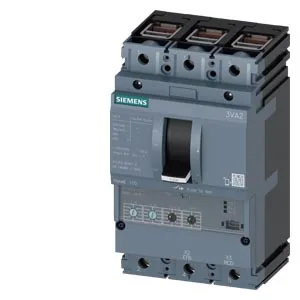
The Siemens SENTRON 3VA2010-5HN36-0JH0 is a 3-pole molded case circuit breaker rated 100 A continuous across the full ambient range from 40 °C to 70 °C — no derating needed up to that ceiling. Interrupting capacity hits 187 kA at 240 V AC, dropping to 121 kA at 415 V and 440 V, then 75.6 kA at 500 V, and 3 kA at 690 V. That's a lot of fault-clearing headroom for a 100 A frame; it's sized for high-available-fault-current panels where a standard 65 kA MCCB would be marginal.
The 105 mm width (4.13 in) is the 3-pole frame width; verify against existing busbar or finger-safety shrouds if retrofitting into a live panel.
Auxiliary wiring and shunt trip note
The shunt trip (STL) lets you remotely open the breaker from a PLC dry contact or emergency-stop circuit — verify the release coil voltage matches your control supply (the order code doesn't encode coil voltage; it's a separate ordering step). The two auxiliary switches plus trip alarm switch give you three discrete status signals: breaker open/closed, and a separate alarm contact that changes state only on a fault trip. Useful for SCADA feedback without adding an external interposing relay.