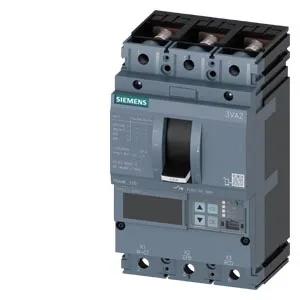
What this 100 A MCCB actually delivers
The Siemens 3VA2010-5JQ32-0AE0 is a 3-pole SENTRON molded case circuit breaker rated for line protection, with a continuous current of 100 A across the full ambient range from 40 °C to 70 °C — no derating needed up to that ceiling. The interrupting capacity tells the real story: 187 kA at 240 V, 121 kA at 415 V and 440 V, 75.6 kA at 500 V, and 3 kA at 690 V. For a 100 A frame, those numbers mean it can sit upstream of a transformer or a feeder panel and still clear a bolted fault without the arc flash climbing upstream. The initial setting starts at 20 A and the full-scale value is 100 A, so it's adjustable within that band — useful when you're protecting a variable load and want to dial in coordination without swapping the breaker. This breaker carries a communication function, which means it can report status or trip events back to a controller — useful for a maintenance team that wants to know why a line dropped without walking the panel. The auxiliary switch configuration is 4 HQ switches, which gives you four independent signal contacts for remote indication or interlocking.
Those dimensions are for the breaker body itself; you'll need to account for the handle throw and any auxiliary wiring space.
What the interrupting ratings mean for coordination
At 240 V, the 187 kA interrupting rating is high enough to be used as a main breaker in most low-voltage switchboards without worrying about series ratings. The drop to 75.6 kA at 500 V and 3 kA at 690 V is typical for a 100 A frame — at 690 V you're limited to relatively low-fault systems.