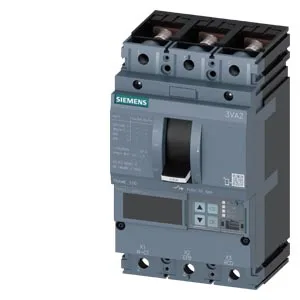
The 3-pole breaker is rated for a maximum of 1 200 A and a minimum of 150 A, so the 100 A setting sits well within its adjustment range. Breaking capacity is the headline number for an MCCB, and this one delivers 187 kA at 240 V, dropping to 121 kA at both 415 V and 440 V, then 75.6 kA at 500 V, and 3 kA at 690 V.
Dimensions are 181 mm tall by 105 mm wide by 86 mm deep — that 105 mm width is three 35 mm DIN-rail modules side by side, so it occupies three full positions on the rail. If you're swapping into an existing panel, check the gland-plate cutout and the bus-bar spacing: the 3-pole footprint is fixed, but the 105 mm width is wider than some compact MCCBs. Power loss is rated at 13.5 W maximum — that's the heat it dumps into the enclosure at full rated current. For a multi-breaker panel, sum those losses to size the ventilation or forced-air cooling.
Communication and auxiliary switching
The breaker includes a communication function, so it can integrate with a building management system or remote monitoring setup — no separate communication module required for basic status. It also ships with a 1 auxiliary switch + 1 trip alarm switch HQ, giving you one set of contacts for breaker position and one for trip indication. That's enough for a remote fault annunciation and a status light on the panel door without adding accessories. The trip indicator is present, so you get a visual flag when the breaker has tripped on fault.