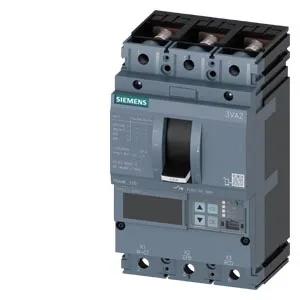
What this MCCB is and what it does
The Siemens 3VA2010-5JQ32-0AJ0 is a SENTRON molded case circuit breaker (MCCB) designed for line protection — the primary job is guarding feeder and branch circuits against overloads and short circuits in low-voltage distribution panels. It's rated 100 A continuously across the entire 40 °C to 70 °C ambient range, so no derating math when the panel runs hot; that's a solid pick for a crowded enclosure where airflow is tight. The 3-pole unit handles three-phase systems, and the 187 kA interrupting capacity at 240 V means it can clear a massive fault without blowing apart — useful when the transformer is close and the available fault current is high.
Breaking capacity across voltages
The interrupting rating drops as voltage climbs: 187 kA at 240 V, 121 kA at 415 V and 440 V, 75.6 kA at 500 V, and 3 kA at 690 V. At 690 V the breaker is still usable but only for relatively low-fault locations — think downstream of a transformer with limited secondary fault current. For most 400 V class industrial panels the 121 kA figure gives plenty of headroom against typical 50-65 kA available fault currents.
Adjustable trip and auxiliary contacts
The breaker has a 20 A minimum trip setting and a 100 A full-scale value. It includes a trip indicator, 2 auxiliary switches plus 1 trip alarm switch HP, and communication function.
Physical fit and panel integration
Dimensions are 86 mm deep, 105 mm wide, 181 mm tall. That 105 mm width (about 4.13 inches) is a standard 3-pole MCCB footprint — it'll drop into most panel-mounted bases or DIN-rail adapters without surprises. The 86 mm depth means it stays clear of gland plates and backpanel wiring troughs in a typical 200 mm deep enclosure. Operating temperature range is -25 °C to 70 °C; storage range is -40 °C to 80 °C, so it can sit in an unheated warehouse or on a truck in winter without damage.
Power loss and thermal management
Maximum power loss is 13.5 W at rated current. That's modest — it won't cook adjacent components, but in a densely packed panel with multiple breakers running near 100 A, it's worth checking the total dissipation against the enclosure's thermal rating.
