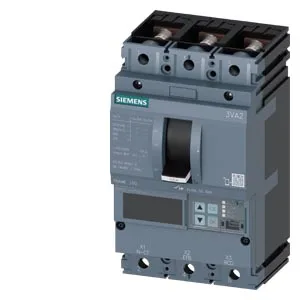
What this MCCB carries on the critical path
The Siemens SENTRON 3VA2010-5KP32-0AE0 is a 3-pole molded case circuit breaker rated for 100 A continuous current across the full ambient range from 40 °C to 70 °C — no derating needed up to that ceiling. The line-protection design means it's built for feeder and main breaker duty, not motor branch-circuit protection. Communication function is onboard, so it can talk to a BMS or PLC without an add-on module.
The 3-pole block occupies one 105 mm-wide slot in a multi-breaker lineup. Power loss is 13.5 W maximum, so thermal rise inside a sealed enclosure stays manageable; just account for it in the heat budget.
At 500 V it still holds 75.6 kA; at 690 V it drops to 3 kA — that last figure is the limit for a 690 V line, so verify the available fault current if feeding a 690 V bus. Selectivity with downstream 3VA1 or 3VA2 breakers is achievable within the published coordination tables.
Auxiliary switch complement and trip indication
This variant ships with four HQ auxiliary switches — that's a full set for remote status monitoring of the main contacts. The trip indicator is absent, meaning the breaker does not have a mechanical flag showing whether it tripped on fault versus being manually opened — something to note for troubleshooting without opening the door.