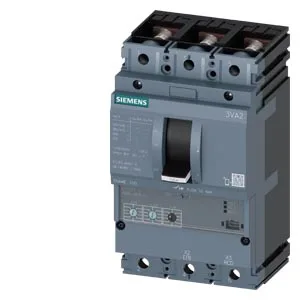
What it is and what it does
The Siemens SENTRON 3VA2010-6HL32-0DH0 is a 3-pole molded case circuit breaker (MCCB) rated for 100 A continuous current across the full ambient range from 40 °C to 70 °C — no derating needed up to that ceiling. It's designed for line protection, meaning it sits at the incoming feed of a panel or distribution board, not downstream on a motor or branch circuit. The 242 kA breaking capacity at 240 V AC is the headline number, but the real-world fit is the 187 kA it still delivers at 415 V and 440 V — that's the range where most industrial switchgear lives. At 690 V it drops to 3 kA, so confirm the fault level if you're feeding a 690 V bus.
Key ratings and what they mean for fit
Continuous current is 100 A, flat from 40 °C to 70 °C. That's unusual — most MCCBs start derating above 40 °C. This one holds its full rating, so if the panel runs hot (say, a non-climate-controlled enclosure near a furnace line), you still get the full 100 A without oversizing the frame. Breaking capacity: 242 kA at 240 V, 187 kA at 415 V and 440 V, 121 kA at 500 V, 3 kA at 690 V. The 187 kA at 415 V is the number that matters for most European and Asian 400 V-class systems — it's high enough to sit on a transformer secondary without needing a current-limiting fuse upstream. The 3 kA at 690 V means this is not the breaker for a 690 V main; use it on the secondary side of a 690/400 V transformer. Includes an undervoltage release (UVR) and 2 auxiliary switches plus 1 trip alarm switch. The UVR means the breaker drops out if the control voltage falls below a threshold — useful for safety circuits where loss of control power should open the main feed. The trip alarm switch gives a separate signal when the breaker trips on fault, not just when manually opened.
Where it goes in a panel
Mounts on a DIN rail or panel-mount base — the 105 mm width and 86 mm depth fit standard distribution board cutouts. The 181 mm height is tall enough that adjacent breakers need the matching SENTRON busbar system for phase spacing. No communication module on this variant, so it's a straight electromechanical breaker — set the trip curve via the dial on the front, wire the UVR coil to a separate 24 V or 230 V control circuit depending on the release coil ordered.
