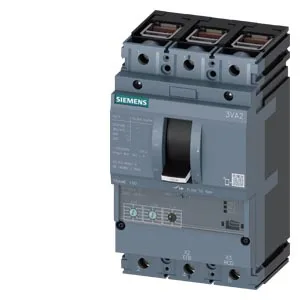
What this MCCB carries and where it fits
The Siemens SENTRON 3VA2110-5HL36-0AH0 is a 3-pole molded case circuit breaker rated for 100 A continuous current (Iu) and fitted with an ETU320 electronic trip unit. It's a line-protection device — no undervoltage release, no ground-fault monitoring, no communication module — built for straightforward feeder or main breaker duty in a distribution panel. The 100 A rating holds flat from 40 °C through 50 °C, then derates to 85 A at 70 °C, so it handles warm enclosures without stepping down a frame size. Breaking capacity is the headline number here: 187 kA at 240 V, 121 kA at 415 V and 440 V, 79 kA at 500 V, and 4.25 kA at 690 V. That 187 kA at 240 V is high for a 100 A frame — it clears a bolted fault on a large transformer secondary without the breaker itself becoming the weak link. The 690 V figure (4.25 kA) is lower, so check available fault current if you're using this on a 690 V line. Auxiliary contact configuration is 2 auxiliary switches plus 1 trip alarm switch (HQ type). That gives you two separate status signals for the panel PLC or indication lamps, plus a dedicated alarm contact that changes state only on a trip — useful for remote fault annunciation without wiring through the aux contacts.
Panel fit and integration
Dimensions are 105 mm wide, 181 mm high, 86 mm deep. That 105 mm width is a standard 3-pole MCCB footprint for this frame size — it fits the same mounting cutout as other SENTRON 3VA breakers in the 100 A class. Front protection is IP40, so it's fine for a clean indoor panel but not for washdown areas. Rated insulation voltage is 800 V, which covers 480/277 V and 600 V systems with margin. The ETU320 trip unit is the electronic, not thermal-magnetic, type — it gives better accuracy and adjustable trip curves if you need coordination downstream. Power loss is 10 W maximum at rated current, so factor that into enclosure thermal calculations.
What the ETU320 means for coordination
The ETU320 is an electronic trip unit with LI (long-time and instantaneous) protection — no short-time delay or ground fault. That's typical for a feeder breaker where you need basic overload and short-circuit protection but don't need selective coordination with downstream breakers. If you need short-time delay for zone-selective interlocking, you'd step up to an ETU350 or higher. The 20 000 mechanical endurance cycles (latching) are standard for this class.
