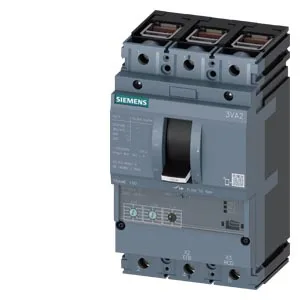
At 55 °C it drops to 96.25 A, at 60 °C to 92.5 A, and at 70 °C to 85 A (–). That thermal curve is what you'd reference for a panel sitting near a furnace line or a roof under summer sun — the breaker doesn't force a full-size bump until you're past 55 °C. The 187 kA at 240 V is the headline interrupting rating; at 690 V it still clears 4.25 kA, which covers most 690 V industrial loads outside the very high-fault zone. The ETU320 is an electronic trip with adjustable overload and short-time settings — not a thermal-magnetic fixed curve, which matters if you need coordination selectivity downstream.
Built-in auxiliary and undervoltage release
No communication function and no phase-failure detection on this build; it's a straightforward line-protection MCCB with remote trip capability via the UVR, not a smart breaker with built-in metering. Power loss max is 12.5 W — negligible for panel thermal budgeting but worth noting if you're stacking several in a sealed enclosure.