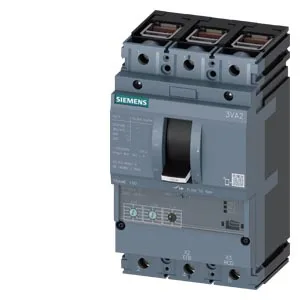
Three-pole construction, designed for line protection (cable/feeder protection, not motor-only duty). The adjustable thermal-magnetic trip unit spans 150 A minimum to 1 200 A maximum — that's a wide magnetic pickup window, so you set the instantaneous trip threshold to coordinate with downstream branch breakers without nuisance tripping on inrush. Breaking capacity is voltage-dependent: 187 kA at 240 V, 121 kA at 415 V and 440 V, 75.6 kA at 500 V, and 3.7 kA at 690 V. At 415 V — common in European industrial distribution — the 121 kA rating handles high-fault scenarios like transformer secondaries or busway taps without cascading upstream.
Maximum power loss is 10 W. In a sealed, non-ventilated enclosure, that 10 W contributes to internal temperature rise; factor it into the thermal calculation if the panel also houses drives or transformers.
Auxiliary hardware onboard
The auxiliary switches signal breaker position to a PLC or status lamp; the alarm switches indicate a trip event separately from normal open/close. No undervoltage release fitted — if undervoltage protection is needed, that's a separate order. The voltage trigger allows a remote signal to initiate a trip — useful in emergency-stop circuits where a safety relay cuts power via the shunt trip rather than dropping out a contactor.