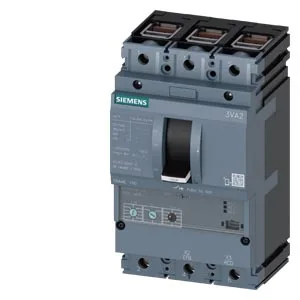
What this MCCB delivers for motor protection
The Siemens SENTRON 3VA2110-7MN36-0BA0 is a 3-pole molded case circuit breaker (MCCB) rated for 100 A continuous current, built specifically for motor protection duty. It carries the ETU350M electronic overcurrent release with phase failure detection, so it catches the unbalance that kills windings before the thermal overload in a starter can respond. The interrupting capacity hits 330 kA at 240 V and 242 kA at 415 V — that is high enough for most distribution boards downstream of a large transformer without cascading upstream breakers.
Ratings that decide the fit
Rated continuous current Iu is 100 A, and it holds that rating from 40 °C up to 50 °C without derating. At 55 °C it steps down to 96 A, at 65 °C to 92 A, and at the maximum 70 °C operating ambient to 90 A. The rated insulation voltage Ui is 800 V, so it is safe for 690 VAC line-to-line systems. Interrupting capacity drops as voltage rises: 330 kA at 240 V, 242 kA at 415 V and 440 V, 187 kA at 500 V, and 52.5 kA at 690 V. That 52.5 kA at 690 V is still well above the typical 50 kA SCCR requirement for most 690 V industrial networks.
Built-in undervoltage release and trip unit
This MCCB ships with an integrated undervoltage release (UVR) as standard — part number 3VA9608-0BB11 — so it drops the load when line voltage falls below a set threshold, which is useful for preventing reclosure after a brownout on motor circuits. The overcurrent release is the ETU350M, a microprocessor-based unit that provides adjustable thermal and magnetic trip curves plus phase failure detection. There is no auxiliary contact block, no communication module, and no voltage-trip release on this variant; those are add-on options if needed later.
Panel integration notes
The 3VA2110-7MN36-0BA0 measures 105 mm wide, 181 mm high, and 86 mm deep. It mounts on a DIN rail or can be screw-fixed to a backplate. The 3-pole footprint matches the standard SENTRON 3VA frame, so it drops into existing panel cutouts without re-drilling. Maximum power loss is 75 W — account for that heat in a sealed enclosure when sizing ventilation.
