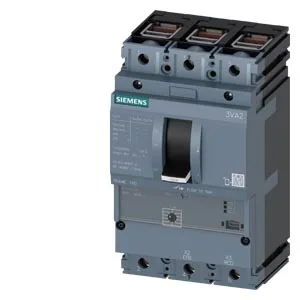
It's built for starter protection — meaning it's designed to sit ahead of a motor starter, handling the short-circuit fault current while the overload relay handles running protection. The interrupting capacity is the headline: 330 kA at 240 V, 242 kA at 415 V and 440 V, 187 kA at 500 V, and still 52.5 kA at 690 V. The shunt trip (STL) allows remote tripping from a PLC or emergency-stop circuit. Operating temperature range is -25 °C to 70 °C, with the current derating curve starting at 55 °C (96 A) and stepping down to 90 A at 70 °C.
The 3VA1110-5EE32-0JA0 is a smaller-frame SENTRON (100 A rated, but typically in a 3VA1 frame with lower interrupting capacity — around 65 kA at 240 V). The 3VA2110-7MS36-0HH0 is the heavy hitter: 330 kA at 240 V vs roughly 65 kA. If your panel's available fault current is under 65 kA, the 3VA1110-5EE32-0JA0 might drop in without rewiring (same 3-pole, same DIN-rail mount), but you'd lose the shunt trip and the ETU310M electronic trip — the 3VA1110 typically uses a thermal-magnetic release. So the swap is about fault-current headroom and trip-unit type, not just physical fit.
What's inside the box — auxiliary release and trip unit detail
The integrated shunt trip (STL) is the 3VA9688-0BL30 auxiliary release. The basic switch (the breaker mechanism itself) is the 3VA2110-7MS36-0AA0 subassembly. The overcurrent release is the ETU310M — an electronic unit with LSI protection curves (long-time, short-time, instantaneous). This is a clean, focused starter-protection breaker with remote trip capability and auxiliary status feedback.