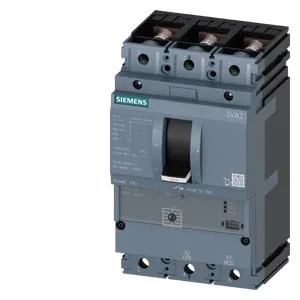
What this MCCB is and what it does
The Siemens 3VA2110-7MS32-0JC0 is a SENTRON molded case circuit breaker (MCCB) designed for starter protection — meaning it's built to sit ahead of a motor starter, handling both overload and short-circuit fault clearing in a single device. It's a 3-pole unit with a rated current of 100 A across the full ambient temperature range from 40 °C to 70 °C, so no derating curve to chase when the panel runs hot. The adjustable thermal-magnetic trip covers 300 A minimum to 1 500 A maximum, giving you a wide coordination window for different motor full-load currents. Breaking capacity is the headline: 330 kA at 240 V AC, 242 kA at 415 V and 440 V, 187 kA at 500 V, and 3.7 kA at 690 V. That 330 kA at 240 V is a high-interrupting rating — it's sized for installations with very high available fault current, like large industrial switchboards or transformer secondaries.
Lifecycle and sourcing reality
The breaker ships with a shunt trip (STL) auxiliary release and two HQ auxiliary switches integrated — those are factory-fitted, not field-addon kits, so the order code already carries the accessories you'd otherwise source separately. The basic switch designation is 3VA21107MS320AA0.
Panel fit and integration
Dimensions are 181 mm high, 105 mm wide, 86 mm deep — a standard SENTRON 3VA frame size that mounts on a DIN rail or panel-mount plate. The 86 mm depth is shallow enough for most 200 mm deep enclosures without a door clearance issue. Power loss is rated at 10 W maximum, which is modest for a 100 A MCCB; ventilation around the breaker is still advisable in a sealed cabinet. Operating temperature range is -25 °C to 70 °C, storage from -40 °C to 80 °C. No undervoltage release, no communication function, no phase failure detection — this is a straightforward thermal-magnetic breaker, not an electronic trip unit with metering. The voltage trigger is present, which means the shunt trip can be wired to a remote emergency-stop or undervoltage coil circuit.
What the ratings mean for your coordination study
The 100 A rating is flat across the full ambient range — no derating needed up to 70 °C, which is unusual for an MCCB and simplifies the panel schedule. The adjustable trip band from 300 A to 1 500 A covers motor FLA from roughly 75 A to 400 A depending on the starter size and coordination rules. The 330 kA SCCR at 240 V is the figure that governs whether this breaker can be placed on a transformer secondary without cascading upstream; at 690 V the 3.7 kA rating is low enough that you'd need a current-limiting upstream device for high-fault 690 V systems.
