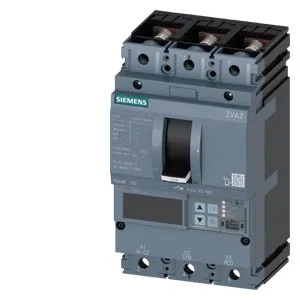
The Siemens SENTRON 3VA2110-8JQ32-0AA0 is a 3-pole molded case circuit breaker (MCCB) rated for 100 A continuous current, designed for line protection in distribution panels. Its 800 V rated insulation voltage and breaking capacity that reaches 440 kA at 240 V mean it can safely interrupt very high fault currents on the line side of a panel — the kind of SCCR you need when feeding a transformer or a busway with a stiff utility source. The 100 A rating holds flat from 40 °C up to 70 °C ambient, so no derating curve to chase in a warm enclosure.
The 440 kA at 240 V and 330 kA at 415 V and 440 V are the ultimate short-circuit breaking capacities (Icu) at those voltages. At 690 V it still holds 52.5 kA. The 150 A minimum and 1 200 A maximum settings on the electronic trip unit give you a wide adjustment band for cable protection or small-motor feeder duty.
Dimensions are 105 mm wide, 181 mm high, 86 mm deep — a standard SENTRON 3VA frame size that drops into a DIN-rail or panel-mount footprint without surprises. The 7.7 W maximum power loss at rated current is low enough that ventilation slots in a typical IP3X enclosure handle the heat; no forced cooling required for a single breaker. Communication function is built in, so it can talk to a higher-level controller or BMS over the SENTRON bus system without an add-on module.
Ground-fault and monitoring capability
No separate ground-fault sensor or zero-sequence CT needed if the breaker is already specified with this option. The trip indicator is not present on this variant, so fault indication comes from the communication interface or a separate auxiliary contact.