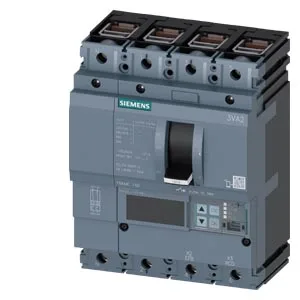
It sits in the SENTRON 3VA family, Siemens' platform for panelboard and main-distribution applications where you need coordinated selectivity and communication capability. Breaking capacity is the headline number here: 242 kA at 240 V, 187 kA at 415 V and 440 V, 121 kA at 500 V, and 3.7 kA at 690 V. The steep drop to 3.7 kA at 690 V tells you this breaker is optimized for low-voltage (240–500 V) distribution, not 690 V motor circuits.
ETU850 trip unit — what it gives you
This matters for a category-sourcing view: if your BOM calls for breakers that report status and current draw to a central SCADA or energy-management system, this variant saves you an add-on module. The trip unit is adjustable between 150 A and 1,200 A — but note the breaker's continuous current rating is fixed at 100 A. That adjustment range covers the long-time pickup (Ir) setting, not the frame rating. You set Ir between 150% and 1200% of the 100 A frame, which is unusual: typically Ir is set below the frame rating. The ETU850 allows a wide window for coordination studies, but the physical conductor and thermal limits of the 100 A frame govern the actual safe continuous load.
Dimensions: 181 mm height, 140 mm width, 86 mm depth. The 86 mm depth means it protrudes less than many 100 A frames, which helps in shallow backpanels or gland-plate clearance. No undervoltage release or shunt trip is fitted as standard (no voltage trigger, no undervoltage release), so if your safety circuit requires a UVR or shunt, you need the accessory variant or a field-installable kit.