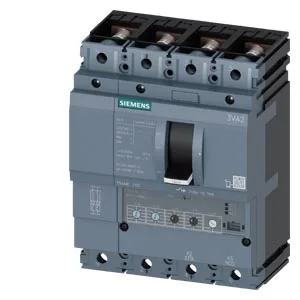
The Siemens SENTRON 3VA2116-6HM42-0AA0 is a 4-pole molded case circuit breaker (MCCB) rated for 160 A continuous current across the full ambient range from 40 °C to 70 °C — no derating needed up to that ceiling. Breaking capacity is the headline number here: 242 kA at 240 V, 187 kA at 415 V and 440 V, 121 kA at 500 V, and 3.7 kA at 690 V. The steep drop to 3.7 kA at 690 V tells you this breaker is optimized for low-voltage distribution up to 500 V; at 690 V it's still usable but the fault-current headroom is much tighter.
Sizing and selectivity in the panel
The 4-pole configuration (switched neutral) is typical for TN-S or IT systems where you need to isolate the neutral alongside the phases. Maximum power loss is 25.5 W — not negligible in a sealed panel with other heat sources. If you need remote tripping or status feedback, you'll add external accessories.
That's a standard 4-pole MCCB footprint — it'll drop into most DIN-rail or panel-mount bases designed for SENTRON 3VA frame sizes. Fine for unheated warehouses and most indoor industrial environments. Ground-fault monitoring uses summation current on L+N — that's a residual-current detection method, not a full ground-fault relay, so it covers line-to-ground faults on the load side but doesn't replace a dedicated GFCI breaker.