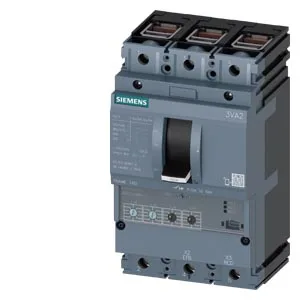
What this MCCB delivers on the line side
The Siemens SENTRON 3VA2116-7HM36-0AA0 is a 3-pole molded case circuit breaker rated 160 A continuous, with a flat thermal derating curve that holds 160 A all the way to 70 °C — no headroom loss at elevated panel temperatures. That 160 A full-scale value matches the continuous current rating, so the breaker is sized for a 160 A feeder or main without needing to oversize for ambient derating. Interrupting capacity is 330 kA at 240 V, dropping to 242 kA at 415 V and 440 V, 187 kA at 500 V, and 3.7 kA at 690 V. The 330 kA at 240 V tells you this breaker is built for high-fault panels — think large transformer secondaries or busway taps where the available fault current is serious. At 690 V the SCCR drops sharply to 3.7 kA, so if you're on a 690 V line, this is not the breaker for that bus. Rated insulation voltage is 800 V, which covers 480 V and 600 V class systems with margin. The design is line protection — not motor circuit protection — so it's a feeder breaker, not a combination starter element.
Panel fit and integration
Dimensions are 181 mm high, 105 mm wide, 86 mm deep — a standard SENTRON 3VA2 footprint. Mounts on a DIN rail or direct panel via the base. The 86 mm depth means it fits flush in a 200 mm deep enclosure with room for rear busbars or wiring gutters. Power loss at rated current is 25.5 W maximum — relevant for enclosure thermal calculations if you're stacking multiple breakers in a sealed panel. Ground-fault monitoring uses summation current formation on the L-conductor, so it can detect residual currents without an external GFCI module.
What the 3VA2116-7HM36-0AA0 does not carry
No undervoltage release, no voltage trigger, no communication function, no trip indicator, and no other measurement function. This is a plain line-protection MCCB — no bells, no remote monitoring, no shunt trip. If your spec calls for an undervoltage coil or Modbus communication, this is not the variant. Operating temperature range is -25 °C to 70 °C; storage range is -40 °C to 80 °C. The storage minimum is the cold-handling limit, not the running limit — the breaker can sit in a cold warehouse but must be above -25 °C to switch load.
