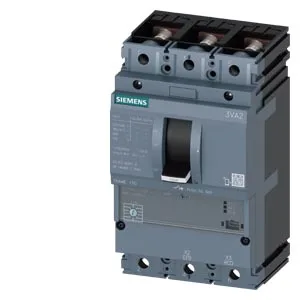
What This MCCB Handles and Where It Fits
That means you can tune it for selective coordination downstream of a main breaker — not just a thermal-magnetic clunk. It's a line-protection design, so it's built for branch-circuit or feeder duty on three-phase systems, not for motor or generator protection. The interrupting ratings are what set this breaker apart. At 240 V it clears 187 kA — enough for high-fault-capacity service entrances or panels fed by large transformers. At 415 V and 440 V you get 121 kA, and at 500 V it still manages 75.6 kA. There's no trip indicator, no undervoltage release, and no ground-fault monitoring built in, so plan for external devices if those are needed. Maximum power dissipation is just 0.6 W — negligible heat inside a sealed enclosure.
Integration Checks for the Panel
Mounts on the standard DIN-rail or panel-mount pattern Siemens uses across the SENTRON 3VA family. Terminals accept copper or aluminum conductors per the manufacturer's torque specs on the nameplate. No communication module means no remote monitoring; if you need that, step up to the 3VA2 with COM option.
What the ETU340 Release Gives You
That's LSI protection — you can set selectivity with downstream breakers on time-current curves, which is harder with a thermal-magnetic that only gives you fixed long-time and instantaneous. It's powered by the load current itself, so no external control power needed. The continuous rating of 25 A is the frame rating; the trip unit lets you dial it down for smaller loads.