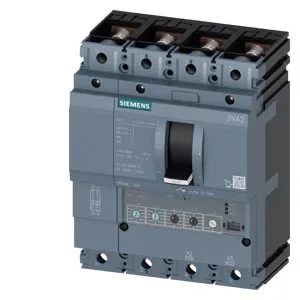
It's a 4-pole unit rated at 25 A continuous with an ETU350 electronic trip unit, so it's handling the feeder or branch circuit in a commercial or industrial switchboard. Insulation voltage is 800 V, which covers 480Y/277 V and 600 V systems with headroom.
At 25 A, this breaker is sized for moderate loads — lighting panels, small motor control centers, or downstream subfeeds. The 4-pole configuration means it switches all three phases plus neutral, which you need on a 3-phase 4-wire system where you want to break the neutral as well. The ETU350 trip unit gives you electronic adjustment of the long-time, short-time, instantaneous, and ground-fault pickup — not a fixed thermal-magnetic, so you can dial in coordination with downstream breakers without swapping the whole device. Dimensions are 140 mm wide, 181 mm tall, and 86 mm deep, so it fits standard SENTRON 3VA panel footprints; check your existing bus stack and door clearance before committing the BOM.
Interrupting capability across voltage levels
The interrupting rating drops as voltage climbs: 242 kA at 240 V, 187 kA at 415 V and 440 V, 121 kA at 500 V, and 3.7 kA at 690 V. That steep drop at 690 V means this isn't your first choice for 690 V wind farm or mining gear unless the available fault current is under 3.7 kA. For standard 480 V panels (common in North America) the 187 kA at 440 V is the closest proxy, and that's plenty for most utility services. The 242 kA at 240 V is what you need for high-capacity 120/208 V switchboards near a large transformer.
What you get on the nameplate
Power loss is minimal at 0.6 W maximum, so heat buildup in a dense panel isn't a concern. Operating temperature range is -25 °C to 70 °C, with storage from -40 °C to 80 °C. Trip indicator is not fitted, so you'll know it tripped by the load loss or a remote status contact if you add one.