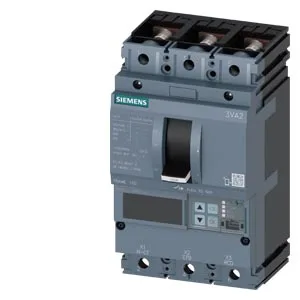
What this MCCB does on the line
It carries a 242 kA breaking capacity at 240 V, dropping to 187 kA at 415 V and 440 V, then to 121 kA at 500 V, and down to 3.7 kA at 690 V — that steep derate above 500 V is the spec to watch if you're feeding a 690 V bus. Maximum power loss is 0.6 W — negligible for panel heat budgeting, but it confirms the trip unit runs cool at rated load. That means it can talk to a higher-level system and report ground faults without a separate GFCI module — a time-saver on a panel build where you'd otherwise add a relay and extra wiring.
That 86 mm depth is the key dimension for enclosure depth clearance — it's shallower than many older MCCB frames, so it fits retrofit panels where the back panel is tight. The 105 mm width per 3-pole unit is standard for the SENTRON 3VA platform, meaning busbar and lug spacing matches the rest of the family.
The 242 kA at 240 V is the headline number, but the real-world fit decision is the 187 kA at 415 V — that's the common 400 V-class industrial distribution voltage. At 690 V the 3.7 kA limit means this is not a 690 V main breaker; it's a feeder or branch device on lower-voltage sections. The 38 A minimum rating and 300 A maximum define the trip-unit adjustment range, not the continuous rating — the 25 A continuous is fixed by the trip unit installed.