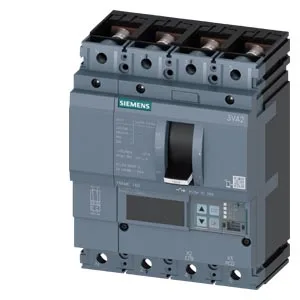
At 415 V it still holds 187 kA, and at 690 V it drops to 3.7 kA — so the real-world fit depends on the available fault current at your service voltage. If your panel has a 200 kA prospective fault at 240 V, this breaker handles it; if the same panel runs at 690 V with a 10 kA fault, the 3.7 kA rating is insufficient and you need a higher-rated MCCB. That is a 25 A frame with a 25 A thermal-magnetic trip unit (fixed, not adjustable). Ground-fault monitoring is built in via summation current formation on L + N conductor — it compares the vector sum of phase and neutral currents and trips if leakage exceeds the threshold. That saves an external ground-fault relay and CT, but note it monitors only the L+N summation, not individual phase-to-ground leakage. For applications requiring per-phase ground-fault detection, you would add a separate module.
The 140 mm width for a 4-pole unit is typical; verify your enclosure's DIN-rail span or backplate space before committing the BOM. The communication function suggests a plug-in communication module (PROFIBUS, PROFINET, or Modbus) that clips onto the front — that module adds no extra width but may protrude forward, so check the door clearance.