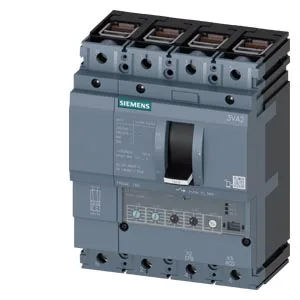
The Siemens 3VA2140-5HN46-0AA0 is a SENTRON 3VA2 molded case circuit breaker (MCCB) rated for 40 A continuous current on a 4-pole frame, fitted with the ETU350 electronic overcurrent release. It's designed for line protection — meaning it sits at the feeder or main distribution point, not on a motor branch. The 187 kA breaking capacity at 240 V tells you this breaker can handle high-fault-current panels without cascading upstream; at 415 V it still interrupts 121 kA, which covers most industrial switchboards. The ETU350 is a programmable electronic trip unit, so you get adjustable long-time, short-time, and instantaneous pickup settings rather than fixed thermal-magnetic curves — useful when you need selectivity downstream.
Breaking capacity and selectivity
The 3VA2140-5HN46-0AA0 carries 187 kA at 240 V, 121 kA at 415 V and 440 V, 75.6 kA at 500 V, and 3.7 kA at 690 V. That steep drop above 500 V is typical for a 40 A frame — at 690 V the arc extinction gets harder. For a 480 V panel (common in North America) you'd interpolate between the 440 V and 500 V figures; the 75.6 kA at 500 V still gives headroom for most service-entrance applications. The 800 V rated insulation voltage confirms the breaker's internal clearances are designed for 690 V systems, but the interrupting rating is what governs safe fault clearing.
Environmental and integration notes
Dimensions are 181 mm high, 140 mm wide, 86 mm deep — a standard 4-pole MCCB footprint that fits most Siemens-compatible panelboards and switchgear cubicles. IP40 on the front means the breaker face is protected against tools and wires >1 mm, but the body is open to the enclosure interior; the panel itself provides the overall IP rating. Operating temperature range is -25 °C to 70 °C, storage from -40 °C to 80 °C, so it's fine for unheated electrical rooms or outdoor enclosures with heaters. Power loss is 1.6 W maximum — negligible for thermal budgeting in a dense panel, but worth noting if you're packing multiple breakers in a small enclosure with limited convection.
