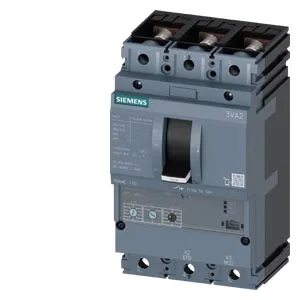
The interrupting ratings climb to 187 kA at 240 V and hold 121 kA at 415/440 V, dropping to 75.6 kA at 500 V and 3.7 kA at 690 V — that SCCR curve tells you this breaker is sized for high-fault industrial distribution, not light commercial. Three poles, built-in undervoltage release (UVR), and phase failure detection are standard on this variant. The UVR drops the breaker if control voltage falls below the dropout threshold — essential for motor starters that need to prevent automatic restart after a brownout. Phase failure detection catches a lost phase before single-phasing cooks the motor windings. Two HQ auxiliary switches come factory-fitted, giving you status feedback without adding external contact blocks. The basic switch assembly carries order code 3VA21405MN320AA0 if you ever need to replace just the switching mechanism.
At 500 V it still holds 75.6 kA, which covers most 480 V plant networks. The sharp drop to 3.7 kA at 690 V means this frame size is not intended for 690 V high-fault applications; if your system runs 690 V with fault currents above 3.7 kA, you need a larger frame or a current-limiting upstream device. Trip time is adjustable between 4 s and 17 s — that's the thermal-magnetic or electronic trip band for overload protection. A 4 s minimum clears fast for short circuits while the 17 s maximum gives the motor starting inrush room to pass without nuisance tripping. Set it tight for short-coupled loads (pumps, fans), wider for high-inertia starts (conveyors, crushers).
The 4.1 W maximum power loss means minimal heat contribution inside a sealed panel; you won't need to oversize the enclosure for thermal management on this breaker alone. If you need Modbus or ground-fault, you're looking at a different suffix in the 3VA2 family.