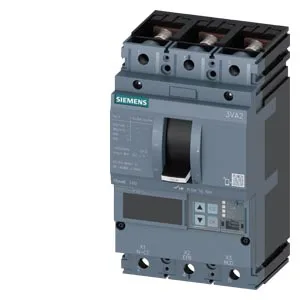
MCCB for line protection — 63 A, 3-pole, high interrupting capacity
The Siemens SENTRON 3VA2163-5JP32-0BC0 is a 3-pole molded case circuit breaker (MCCB) rated for 63 A continuous current across the full ambient temperature range from 40 °C to 70 °C — no derating needed up to that ceiling. It is designed for line protection in distribution panels and switchboards, with a trip-current range spanning 95 A minimum to 756 A maximum, so it handles both moderate overloads and hard faults. The interrupting capacity hits 187 kA at 240 V, 121 kA at 415/440 V, and still holds 75.6 kA at 500 V, dropping to 3.7 kA at 690 V — numbers that tell you this breaker is built for high-fault-current installations where upstream coordination matters.
Built-in undervoltage release and auxiliary switches
This MCCB ships with an undervoltage release (UVR) factory-installed — that is the auxiliary release type listed as — plus two HQ auxiliary switches. The UVR trips the breaker when supply voltage drops below a threshold, which is standard for motor feeder protection or emergency-stop circuits where you want the breaker to drop out on loss of control power. The two auxiliary switches provide status feedback (open/closed) to a PLC or indication lamp. Communication function is onboard, so this breaker can talk to a higher-level system for remote monitoring or trip-event logging — useful for a panel that needs to report breaker status without pulling separate sense wires.
Mounting and panel fit
Dimensions are 105 mm wide, 181 mm high, 86 mm deep — standard MCCB footprint for a 3-pole 63 A frame. Mounts on a DIN rail or directly to a backplate via the breaker's own mounting points. The 86 mm depth leaves room for rear-access wiring in a typical 200 mm deep enclosure. No special cutout beyond the standard DIN-rail slot or bolt pattern.
SCCR headroom for coordination studies
For an engineer doing a selective coordination study: this breaker's 187 kA at 240 V and 121 kA at 415 V means it can sit downstream of a larger feeder breaker without needing a current-limiting fuse upstream in most commercial panels. The 3.7 kA at 690 V is a sharp drop — that is the limit for 690 V systems, so if your line voltage is 690 V, verify the available fault current is under that. The 63 A continuous rating holds flat across the full 40–70 °C ambient range, which simplifies derating calculations in a warm enclosure.
