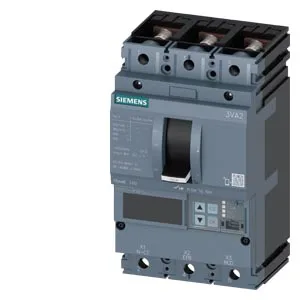
The Siemens 3VA2163-5JP32-0JL0 is a 3-pole SENTRON molded case circuit breaker rated for 63 A continuous current (Iu) at up to 40 °C, with the ETU550 electronic trip unit handling the overcurrent protection. The 187 kA breaking capacity at 240 V AC tells you this breaker can interrupt a very high fault current without welding its contacts or venting plasma into the panel; at 415 V and 440 V it still holds 121 kA. That means you can coordinate it downstream with smaller MCCBs or fused switches and upstream with a main breaker or transformer secondary protection.
At 240 V the breaker is rated for 187 kA; at 415 V and 440 V it drops to 121 kA; at 500 V it's 79 kA; and at 690 V it's 4.25 kA. For most 400 V distribution panels, 121 kA is well above what you'll see on a transformer secondary, so you've got headroom for selectivity.
Auxiliary and trip options built in
The auxiliary contact set gives you two form-C auxiliary switches, one trip alarm switch (flags when the breaker trips on fault), and one electrical alarm switch (flags when the breaker is open for any reason). The undervoltage release is not fitted, so if you need UVR for undervoltage protection you'd need a different variant or an add-on module. Phase failure detection is also absent; the ETU550 handles phase loss through its long-time curve but doesn't have a dedicated phase-failure element.
The breaker carries 63 A continuously up to 50 °C without derating. Above that, it steps down: 60.6375 A at 55 °C, 58.275 A at 60 °C, 55.9125 A at 65 °C, and 53.55 A at 70 °C (–). If the breaker lives inside a hot enclosure — say next to a transformer or in a non-ventilated panel — you'll need to apply that derating or upsize the frame. The 4 W maximum power loss is low enough that heat buildup from the breaker itself is minimal; the derating is driven by the ambient, not self-heating.