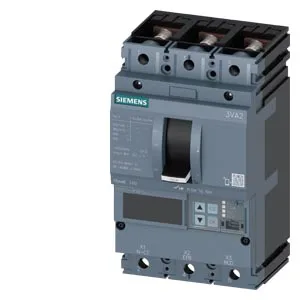
The Siemens SENTRON 3VA2163-5JP32-0KA0 is a 3-pole molded case circuit breaker (MCCB) rated for 63 A continuous current, designed for line protection in distribution panels and industrial switchboards. It carries a breaking capacity of 187 kA at 240 V and 121 kA at 415 V, so it handles high-fault-current scenarios like transformer secondaries or large motor branch circuits without cascading upstream.
Breaking capacity and thermal performance
The breaker's interrupting rating drops with voltage: 187 kA at 240 V, 121 kA at both 415 V and 440 V, 75.6 kA at 500 V, and 3.7 kA at 690 V. That steep derating at 690 V means it's not a primary choice for 690 V motor feeders unless the available fault current is well under 4 kA. The 63 A rating holds flat across the full ambient range from 40 °C to 70 °C — no derating needed for elevated panel temperatures up to 70 °C operating ambient. Rated insulation voltage is 800 V, which covers most 480/277 V and 600 V systems with margin.
The breaker measures 105 mm wide, 181 mm high, and 86 mm deep. That 105 mm width is standard for a 3-pole MCCB in the SENTRON 3VA2 form factor — it fits existing panel cutouts and busbar spacing designed for the series.
Auxiliary release and communication
It also has a communication function (likely PROFIBUS or PROFINET depending on the communication module fitted), enabling status monitoring and remote operation from a PLC or SCADA. No undervoltage release is fitted on this unit; if undervoltage protection is needed, that's a different variant.